
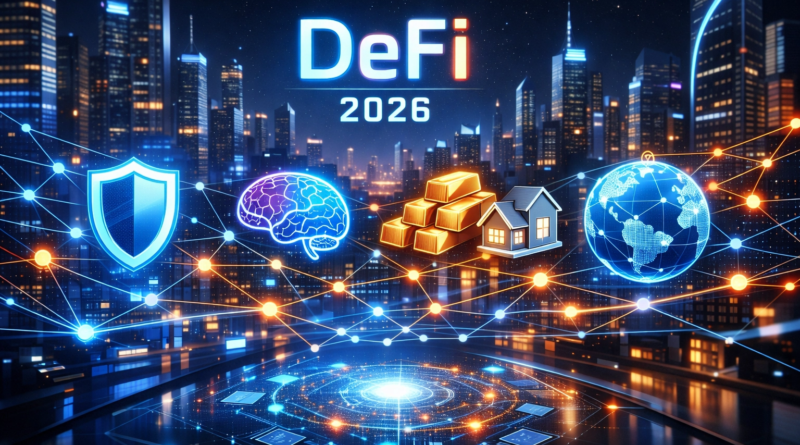
The Future of Decentralized Finance (DeFi) in 2026: Trends, Risks, and Opportunities
Introduction: DeFi’s Evolving Landscape in 2026
Decentralized Finance (DeFi) has rapidly emerged as a transformative force in the global financial landscape, promising a future where financial services are open, transparent, and accessible to everyone, free from traditional intermediaries. What began as a niche application of blockchain technology has evolved into a complex ecosystem of lending, borrowing, trading, and asset management, challenging the very foundations of conventional finance.
The year 2025 witnessed significant growth and maturation within the DeFi space. We saw traditional finance (TradFi) players tentatively stepping into the decentralized arena, more protocols launching their own sovereign blockchains, and fintech firms integrating DeFi functionalities into their offerings at an unprecedented pace . Banks began experimenting with stablecoins, asset managers allocated billions to DeFi lenders, and Wall Street firms piled into tokenized assets. This period marked a crucial bridge-building phase between the established financial world and the burgeoning decentralized one.
As we step into 2026, DeFi stands at a pivotal juncture. This year is poised to redefine its trajectory, pushing it further into the mainstream while simultaneously demanding greater robustness, regulatory clarity, and user-friendliness. The initial hype has given way to a more pragmatic approach, focusing on sustainable growth, real-world utility, and institutional adoption. Understanding the dynamics of this evolving landscape is crucial for investors, builders, and anyone interested in the future of finance.
In this comprehensive article, we will delve into the key trends that are set to shape DeFi in 2026, explore the inherent risks and challenges that persist, and identify the most promising opportunities for growth and investment. From unified stablecoin layers to the increasing rivalry between decentralized and centralized exchanges, and the critical push for privacy and tokenization, we will provide a detailed outlook on what to expect in the decentralized financial world this year.
I. Key Trends Shaping DeFi in 2026
The DeFi ecosystem is a dynamic and rapidly innovating space. Several key trends are converging to redefine its structure, functionality, and reach in 2026.
1. Unified Stablecoin Layers: Solving Liquidity Fragmentation
One of the most significant challenges that plagued DeFi in previous years was liquidity fragmentation. Stablecoins, which are crucial for stability and trading within the crypto ecosystem, were spread across numerous trading venues, blockchains, and exchanges. This dispersion made it difficult for traders to execute large orders efficiently, leading to higher transaction costs, increased price volatility, and reduced overall market efficiency .
In 2026, a major trend is the concerted effort by stablecoin issuers to address this issue through the development and adoption of unified liquidity layers. Projects like Circle’s Cross-Chain Transfer Protocol (CCTP) and Tether’s USDT0 are leading the charge. CCTP allows developers to transfer USDC across different blockchains with native burning and minting, effectively creating a seamless flow of liquidity. Similarly, USDT0 functions as an omnichain stablecoin, operating as a single asset across multiple blockchains.
The impact of these unified layers is profound: stablecoin transfers and conversions become more capital-efficient, cheaper, and significantly more predictable. This enhanced efficiency is not only beneficial for individual users but is also a critical factor in attracting larger institutional players who demand robust and liquid markets.
2. DEXs Rivaling CEXs: The Rise of Decentralized Trading
For a long time, decentralized exchanges (DEXs) were seen as a compromise: they offered permissionless trading but often lagged behind centralized exchanges (CEXs) in terms of liquidity, speed, and user experience. However, 2025 marked a turning point, and in 2026, DEXs are increasingly poised to rival, and in some cases even surpass, their centralized counterparts.
This evolution is driven by several factors. Improvements in user experience, the introduction of intents-based trading, and the emergence of dark Automated Market Maker (AMM) models on platforms like Solana have made some DEXs incredibly competitive. These innovations offer more efficient trade execution, better price discovery, and a smoother trading experience that can now stand toe-to-toe with CEXs .
Simultaneously, there’s a growing sentiment of distrust towards centralized exchanges, fueled by past security breaches, operational failures, and instances of account restrictions. High-profile incidents in 2025, such as cybercriminal activities targeting customer data on major CEXs and system failures leading to significant user losses, have pushed traders towards more transparent and self-custodial options .
As a result, the proportion of crypto trading conducted on DEXs has grown significantly. While it might be too soon for DEXs to overtake CEXs in absolute trading volume by the end of 2026, they are projected to capture a substantial portion of the market, potentially reaching 50% of all crypto trading volume . This shift underscores a broader movement towards greater financial autonomy and transparency within the crypto community.
3. Privacy Push Fuels Adoption: Securing Financial Anonymity
Privacy has emerged as a paramount concern in DeFi, particularly as the ecosystem attracts more institutional interest. While blockchain’s transparency is a core feature, the public nature of transactions can be a deterrent for individuals and institutions who require confidentiality for their financial activities.
In 2026, we are witnessing a significant push for enhanced privacy solutions within DeFi. This includes the continued growth of privacy-focused blockchains like Zcash, which saw a substantial rally in late 2025, and expanded efforts by major blockchain foundations, such as Ethereum, to embed privacy features directly into their networks .
Advocates argue that financial privacy is not about illicit activities but about fundamental personal and corporate security. Just as traditional bank statements are private, users often do not want their entire financial lives exposed on public blockchains. For institutions, the lack of built-in privacy presents a dilemma: gain the benefits of blockchain efficiency at the risk of exposing sensitive pricing, strategy, or investment positions, or stick to slower, less efficient traditional rails .
This drive for privacy is expected to spur a new wave of institutional adoption. Solutions like private multi-signature wallets and privacy-compatible security features are becoming prerequisites for many traditional financial entities looking to make the jump onto the blockchain. The development of robust privacy infrastructure will be a critical enabler for DeFi’s continued expansion and integration into the broader financial system.
4. Tokenization of Real-World Assets (RWAs): Bridging TradFi and DeFi
One of the most transformative trends in DeFi for 2026 is the accelerating tokenization of Real-World Assets (RWAs). This involves representing tangible assets (like real estate, gold, art, and commodities) and intangible assets (such as intellectual property, carbon credits, and even future revenue streams) as digital tokens on a blockchain. This process unlocks unprecedented levels of efficiency, liquidity, and accessibility for assets that were traditionally illiquid and difficult to transfer .
The growth drivers for RWA tokenization are clear: it reduces intermediaries, lowers transaction costs, enables fractional ownership, and provides 24/7 trading capabilities. For instance, tokenized real estate can be bought and sold in smaller units, making it accessible to a wider range of investors and increasing its liquidity. Similarly, tokenized commodities can streamline supply chains and facilitate more efficient trading.
This trend is crucial for bridging the gap between traditional finance (TradFi) and DeFi. By bringing real-world assets onto the blockchain, DeFi platforms can offer new investment avenues that are backed by tangible value, potentially attracting a massive influx of capital from conventional markets. This integration is expected to create hybrid financial products and services that combine the best of both worlds: the stability and regulatory compliance of TradFi with the efficiency and transparency of DeFi.
5. AI Integration in DeFi: Enhanced Efficiency and Intelligence
The convergence of Artificial Intelligence (AI) and DeFi is another powerful trend set to redefine the ecosystem in 2026. AI is being increasingly deployed across various aspects of DeFi to enhance efficiency, automate processes, and provide more intelligent insights .
Applications of AI in DeFi include:
•Risk Management: AI algorithms can analyze vast amounts of data to identify potential risks, predict market movements, and optimize collateral management in lending protocols.
•Algorithmic Trading: AI-powered bots can execute complex trading strategies, identify arbitrage opportunities, and manage portfolios with greater speed and precision than human traders.
•Yield Optimization: AI can help users and protocols identify the most profitable yield farming strategies, dynamically rebalancing portfolios to maximize returns while managing risk.
•Fraud Detection: AI can analyze transaction patterns to detect and prevent fraudulent activities and exploits within DeFi protocols.
While the benefits of AI integration are substantial, offering enhanced automation, predictive capabilities, and overall efficiency, there are also significant challenges. These include ethical considerations regarding algorithmic bias, concerns about data privacy, and the potential for AI-driven systems to create new vulnerabilities if not properly secured and audited. Nevertheless, the synergy between AI and DeFi is expected to drive significant innovation and efficiency gains in the coming year.
6. Cross-Chain Interoperability: Towards a Unified Blockchain Ecosystem
The early days of blockchain saw a fragmented landscape, with numerous independent chains operating in isolation. This lack of communication and asset transfer between different blockchain ecosystems limited liquidity, hindered user experience, and prevented the full realization of DeFi’s potential. In 2026, cross-chain interoperability is a critical trend aimed at overcoming these barriers.
Advanced solutions such as sophisticated bridges, layer-zero protocols (like Polkadot and Cosmos), and multi-chain frameworks are enabling seamless asset transfer and communication across disparate blockchains. These technologies allow users to move tokens and data between different networks without relying on centralized intermediaries, fostering a more unified and interconnected DeFi landscape .
The impact of enhanced interoperability is far-reaching. It increases overall liquidity by allowing assets to flow freely across chains, improves user experience by simplifying multi-chain interactions, and unlocks new possibilities for innovative DeFi applications that can leverage the strengths of various blockchains. This trend is essential for DeFi to scale and achieve its vision of a truly global and accessible financial system.
III. Regulatory Landscape and its Impact on DeFi in 2026
The explosive growth of DeFi has not gone unnoticed by regulators worldwide. In 2026, the regulatory landscape is becoming a defining factor for the industry’s future. While some view regulation as a threat to DeFi’s decentralized ethos, others see it as a necessary step towards mainstream adoption and long-term sustainability.
A key development is the implementation of the Markets in Crypto-Assets (MiCA) regulation in Europe, which provides a comprehensive legal framework for crypto assets. In the United States, Congress is actively debating so-called “market infrastructure” bills that aim to establish a clear regulatory regime for digital assets . These regulatory efforts are focused on several key areas:
•Anti-Money Laundering (AML) and Know Your Customer (KYC): Regulators are pushing for greater compliance with AML and KYC requirements to prevent illicit activities.
•The Travel Rule: This rule requires financial institutions to share information about the originator and beneficiary of transactions, a requirement that poses significant technical challenges for DeFi protocols.
•Investor Protection: Regulators are keen to protect consumers from fraud, market manipulation, and the high risks associated with DeFi.
The impact of this increasing regulatory scrutiny is twofold. On one hand, it could stifle innovation by imposing heavy compliance burdens on DeFi projects. On the other hand, regulatory clarity could legitimize the industry, build trust, and attract a wave of institutional capital that has so far remained on the sidelines. The challenge for DeFi protocols in 2026 is to adapt to this new reality, integrating compliance solutions without sacrificing their core principles of decentralization and transparency.
IV. Investment Opportunities in DeFi for 2026
Despite the challenges, DeFi in 2026 presents a wealth of investment opportunities for those who understand the landscape. Several emerging sectors are showing particularly strong potential:
•Liquid Staking Derivatives (LSDs): These protocols allow users to stake their crypto assets while receiving a liquid token that can be used in other DeFi applications, unlocking liquidity and maximizing yield.
•Real-World Asset (RWA) Tokenization Platforms: As the tokenization trend accelerates, platforms that facilitate the creation and trading of RWAs are poised for significant growth.
•Decentralized Perpetuals: These platforms offer decentralized derivatives trading, a market that has traditionally been dominated by centralized exchanges.
•DeFi Vaults: Automated yield-optimizing vaults that employ sophisticated strategies are becoming increasingly popular for investors seeking passive income .
When evaluating investment opportunities, it’s crucial to look for protocols with strong fundamentals, including a clear use case, a dedicated development team, a robust security model, and a vibrant community. While the potential for high returns is a major draw, it’s equally important to conduct thorough due diligence and to approach DeFi with a clear understanding of the risks involved.
V. Risks and Challenges in DeFi in 2026
While the future of DeFi is bright, it is not without its risks and challenges. Investors and users must remain vigilant and aware of the potential pitfalls:
•Security Vulnerabilities: The threat of hacks, exploits, and smart contract bugs remains a significant concern. Despite advancements in security audits and best practices, the complexity of DeFi protocols means that vulnerabilities can still be exploited.
•Regulatory Uncertainty: The evolving and often fragmented nature of global crypto regulations creates uncertainty for builders and investors alike. Sudden changes in policy can have a significant impact on the market.
•Market Volatility: The prices of crypto assets are notoriously volatile, and this volatility can be amplified in the DeFi space. Investors must be prepared for significant price swings.
•User Experience (UX): While UX has improved, many DeFi applications remain complex and intimidating for mainstream users. Simplifying the user journey is crucial for broader adoption.
•Centralization Risks: Ironically, some aspects of the DeFi ecosystem still exhibit centralization pressures, such as reliance on a small number of infrastructure providers or governance models that can be dominated by a few large token holders.
•Environmental Concerns: The energy consumption of some proof-of-work blockchains remains a concern, although the industry is increasingly shifting towards more energy-efficient proof-of-stake models.
VI. Conclusion: Navigating the Decentralized Future
DeFi in 2026 is a dynamic and rapidly maturing ecosystem with the potential to reshape the future of finance. The trends of unified stablecoin layers, the rise of DEXs, the push for privacy, the tokenization of real-world assets, AI integration, and cross-chain interoperability are all converging to create a more efficient, accessible, and transparent financial system.
However, the path forward is not without its obstacles. Regulatory hurdles, security risks, and market volatility require a balanced and informed approach from all participants. The future of DeFi will depend on the industry’s ability to innovate responsibly, embrace regulatory clarity, and build user-friendly applications that solve real-world problems.
For investors, builders, and users, 2026 offers a unique opportunity to be part of this financial revolution. By staying informed, conducting thorough due diligence, and approaching the space with a clear understanding of its dynamics, we can all play a role in navigating the decentralized future and unlocking its transformative potential.
The Psychology of Happiness : Science-Backed Strategies for a Fulfilling Life
Pingback: The Rise of AI-Driven Personal Finance : How Generative AI