
The Psychology of Habits: How to Build Better Routines and Break Bad Ones
Introduction: The Invisible Architects of Our Lives
Have you ever found yourself performing an action almost unconsciously, like reaching for your phone the moment you wake up, or automatically making a cup of coffee as you start your workday? These seemingly small, repetitive actions are not random; they are habits – the invisible architects that subtly, yet profoundly, shape our daily lives. From our morning routines to our evening wind-downs, habits dictate a significant portion of our behavior, often without us even realizing it.
Habits are automatic behaviors triggered by specific contexts, and their cumulative impact on our lives is immense. They are the silent forces behind our successes, our struggles, our health, our productivity, and ultimately, our destiny. While often dismissed as mere routines, habits are deeply ingrained neurological patterns that, once formed, are incredibly powerful and resistant to change. Understanding this underlying psychology is not just a matter of curiosity; it’s a crucial skill for anyone looking to master their own behavior and achieve lasting personal growth.
This article aims to be your comprehensive guide to unlocking the science of habits. We will delve deep into the psychology behind habit formation, deconstruct the intricate “habit loop” that governs our automatic behaviors, and draw invaluable insights from leading experts like James Clear (author of Atomic Habits) and Charles Duhigg (author of The Power of Habit). Most importantly, we will equip you with actionable, evidence-based strategies to consciously build positive routines and effectively break free from negative ones.
By understanding and mastering the psychology of habits, you can transform your daily actions, elevate your productivity, enhance your well-being, and ultimately, sculpt the life you truly desire. It’s time to stop letting your habits control you and start designing them to serve your highest aspirations.
The Science of Automaticity: What Are Habits?
At its core, a habit is a behavior that has been repeated enough times to become automatic. It’s a mental shortcut, a learned sequence of actions that the brain executes with minimal conscious effort. This automaticity is a remarkable evolutionary adaptation, allowing our brains to conserve energy and focus on novel or complex tasks .
1. Defining Habits : More Than Just Routines
While often used interchangeably, there’s a subtle but important distinction between a routine and a habit. A routine is a sequence of actions regularly followed, but it may still require conscious thought and effort. A habit, on the other hand, is a routine that has become so ingrained that it’s performed almost without thinking, often triggered by specific environmental cues. For example, brushing your teeth every morning is likely a habit; planning your weekly grocery list might be a routine.
2. The Brain on Autopilot: The Neuroscience of Habits
The formation and execution of habits are primarily governed by a part of the brain called the basal ganglia. This ancient region, located deep within the brain, is responsible for motor control, learning, and the development of automatic behaviors. When we repeat an action in a consistent context, the neural pathways associated with that action strengthen, and the basal ganglia takes over, essentially automating the process .
Initially, when we learn a new behavior, the prefrontal cortex (the part of the brain responsible for conscious thought, planning, and decision-making) is highly active. However, as the behavior becomes habitual, activity in the prefrontal cortex decreases, and the basal ganglia becomes more dominant. This shift is what allows us to perform habits efficiently, almost on autopilot, freeing up our conscious mind for other tasks.
3. The Efficiency of Habits: A Cognitive Advantage
From a cognitive perspective, habits are incredibly efficient. Imagine if you had to consciously think through every single step of making your morning coffee, from boiling the water to adding sugar. It would be an exhausting and time-consuming process. Habits allow us to perform these sequences of actions quickly and effectively, without draining our mental energy. This cognitive efficiency is a major reason why habits are so prevalent and powerful in our lives. They enable us to navigate our day with greater ease, allowing us to allocate our limited attention and willpower to more demanding challenges .
Deconstructing the Habit Loop: Cue, Craving, Response, Reward
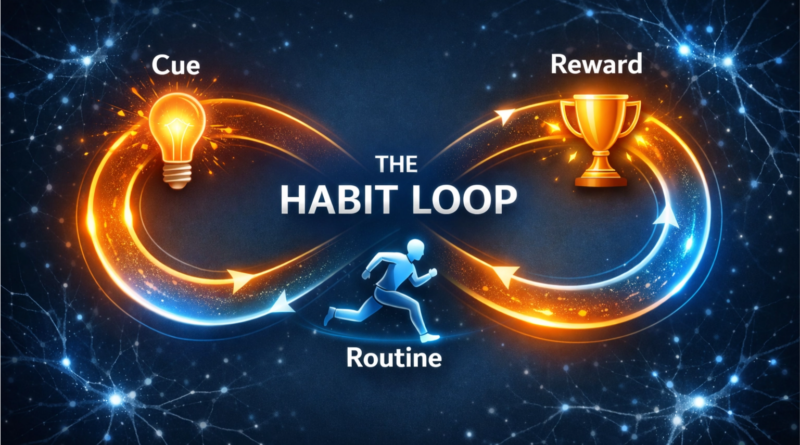
The most influential model for understanding how habits work is the Habit Loop, popularized by Charles Duhigg in The Power of Habit and further refined by James Clear in Atomic Habits. This loop describes the neurological feedback mechanism that governs every habit, whether good or bad. While Duhigg initially outlined a three-step process (Cue, Routine, Reward), Clear expanded it into four more granular steps: Cue, Craving, Response, and Reward .
1. The Cue (Trigger): The Spark that Ignites the Habit
Every habit begins with a cue, a trigger that tells your brain to initiate a particular behavior. Cues are pieces of information that predict a reward. They can be anything from a specific time of day, a location, an emotional state, the presence of certain people, or even the completion of a preceding action. For example:
•Time: Waking up in the morning (cue for making coffee).
•Location: Walking into the kitchen (cue for grabbing a snack).
•Emotional State: Feeling stressed or bored (cue for checking social media).
•Other People: Seeing a friend light a cigarette (cue for smoking).
•Preceding Action: Finishing a meal (cue for brushing teeth).
The key is that the cue is the first signal, the prompt that sets the entire habit loop in motion. Without a cue, the habit often won’t be triggered.
2. The Craving (Motivation): The Anticipation of the Reward
The cue, by itself, isn’t enough to drive a habit. It needs to create a craving – the motivational force behind every habit. A craving is not about the habit itself, but about the anticipation of the reward the habit will deliver. It’s the desire for a change in your internal state, whether that’s a feeling of pleasure, relief from discomfort, a sense of accomplishment, or a feeling of belonging.
For instance, the craving for coffee isn’t necessarily for the taste of coffee, but for the alertness and energy it provides. The craving for social media isn’t for the act of scrolling, but for the distraction, connection, or validation it offers. Cravings are the underlying desires that make habits powerful; they are the “want” that fuels the “do.”
3. The Response (Behavior): The Habit Itself
The response is the actual habit you perform – the physical or mental action you take. This is the most visible part of the habit loop. The response can be a simple action, like taking a sip of water, or a complex sequence, like performing a workout routine. The likelihood of performing the response depends on two main factors:
•Physical Ability: You must be physically capable of performing the action.
•Motivation Level: The stronger the craving and the easier the action, the more likely you are to perform the response.
It’s important to remember that the response doesn’t have to be perfect; it just needs to be performed consistently enough to reinforce the loop.
4. The Reward (Satisfaction): The Reinforcer
The reward is the end goal of every habit. It’s the benefit the habit delivers, satisfying the craving and providing a positive reinforcement that makes the brain want to repeat the behavior in the future. Rewards teach our brains which actions are worth remembering and repeating. They can be immediate and tangible, or more subtle and psychological:
•Immediate Pleasure: The taste of food, the rush of exercise, the satisfaction of a clean space.
•Relief from Discomfort: The easing of hunger, the reduction of stress, the alleviation of boredom.
•Sense of Accomplishment: Checking off a task, learning a new skill.
•Social Approval: Receiving likes on social media, praise from a colleague.
The Feedback Loop: Strengthening the Habit
The entire habit loop operates as a powerful feedback mechanism. The cue triggers a craving, which motivates a response, which delivers a reward. This reward, in turn, reinforces the association between the cue and the response, making it more likely that the same cue will trigger the same craving and response in the future. Over time, this loop becomes increasingly automatic, solidifying the habit .
Understanding this loop is the first critical step in gaining control over your habits. By identifying each component, you can begin to consciously manipulate them to build the habits you want and dismantle the ones you don’t. The power lies not in willpower alone, but in redesigning your habit loops.
Insights from the Masters: James Clear and Charles Duhigg
While the habit loop provides a fundamental understanding, two contemporary authors have significantly advanced our practical application of habit science: Charles Duhigg with The Power of Habit and James Clear with Atomic Habits. Their work offers complementary perspectives on how to leverage habits for personal transformation.
1. Charles Duhigg’s “The Power of Habit”: The Golden Rule of Habit Change
Charles Duhigg’s seminal work, The Power of Habit: Why We Do What We Do in Life and Business, published in 2012, brought the concept of the habit loop into mainstream consciousness. Duhigg meticulously illustrates how habits function in individuals, organizations, and societies, emphasizing that understanding the loop is the key to changing behavior .
Key Takeaway: Duhigg argues that habits are never truly eradicated; instead, they can be changed by manipulating the habit loop. His most profound insight is the “Golden Rule of Habit Change”: you can replace an old habit with a new one by keeping the same cue and reward, but changing the routine. This is particularly effective for breaking bad habits.
For example, if your cue is stress and your reward is a feeling of calm, you might have a routine of smoking. To change this, you keep the stress (cue) and the desire for calm (reward), but replace smoking with a new routine, such as meditation, a quick walk, or deep breathing exercises. The brain still gets its anticipated reward, but through a healthier behavior.
Duhigg also highlights the critical role of belief and willpower. He suggests that for habit change to stick, especially during times of stress, individuals must believe that change is possible. Willpower, while a finite resource, can be strengthened and strategically deployed to initiate new routines until they become automatic.
2. James Clear’s “Atomic Habits”: The Power of Tiny Gains
James Clear’s Atomic Habits: An Easy & Proven Way to Build Good Habits & Break Bad Ones, published in 2018, builds upon Duhigg’s foundation, offering a highly practical and actionable framework for habit formation. Clear’s central premise is that small, incremental changes – “atomic habits” – compound over time to create remarkable results . He emphasizes that true behavior change is not about willpower, but about designing systems that make good habits inevitable and bad habits impossible.
Clear refines the habit loop into four distinct laws of behavior change, each corresponding to a stage of the habit loop, and provides inverse laws for breaking bad habits:
The Four Laws of Behavior Change (for Building Good Habits):
1.Make it Obvious (Cue): To initiate a good habit, make its cue impossible to ignore. This involves designing your environment to make good habits visible and accessible. For example, if you want to practice guitar more, leave it out in the living room instead of tucked away in a closet.
2.Make it Attractive (Craving): Increase your desire for the habit by associating it with positive feelings. This can be achieved through temptation bundling (pairing an action you want to do with an action you need to do) or by reframing your mindset about the habit. For instance, instead of seeing exercise as a chore, view it as an opportunity to gain energy and strength.
3.Make it Easy (Response): Reduce the friction associated with performing the habit. The easier a habit is to start, the more likely you are to do it. Clear advocates for the “2-Minute Rule,” which suggests that any new habit should take less than two minutes to do. For example, “read for 30 minutes” becomes “read one page.”
4.Make it Satisfying (Reward): Ensure that the reward for performing the good habit is immediate and enjoyable. Our brains are wired for instant gratification. If a habit feels good immediately, you’re more likely to repeat it. This can involve habit tracking (seeing your progress is satisfying) or giving yourself small, immediate rewards.
Clear also introduces the concept of identity-based habits, arguing that lasting change comes from focusing on who you want to become, rather than just what you want to achieve. When your habits align with your desired identity, they become a natural extension of who you are.
Both Duhigg and Clear underscore that habits are not about isolated acts of willpower but about understanding and strategically redesigning the systems that govern our behavior. By applying their insights, individuals can move beyond temporary motivation and build sustainable patterns for long-term success.
Practical Strategies for Building Good Habits
Armed with an understanding of the habit loop and the insights from leading habit researchers, we can now turn our attention to actionable strategies for intentionally building good habits. The goal is to make good habits as easy, attractive, obvious, and satisfying as possible .
1. Habit Stacking: Leveraging Existing Routines
Concept: Habit stacking involves linking a new habit to an existing one. Instead of trying to remember to do something new, you simply add it to a behavior you already perform automatically. The existing habit acts as the cue for the new habit.
How to do it: Use the formula: “After [CURRENT HABIT], I will [NEW HABIT].”
•Example: “After I pour my morning coffee, I will meditate for one minute.”
•Example: “After I take off my work shoes, I will immediately change into my workout clothes.”
This strategy leverages the power of existing cues, making it easier to initiate new behaviors without relying on willpower.
2. Environment Design: Shaping Your Surroundings for Success
Concept: Your environment is a powerful, often overlooked, determinant of your habits. By intentionally designing your surroundings, you can make good habits more obvious and accessible, and bad habits less so.
How to do it:
•Make good habits visible: If you want to drink more water, keep a full water bottle on your desk. If you want to read more, place a book on your pillow.
•Reduce friction for good habits: Prepare your gym clothes the night before. Lay out ingredients for a healthy breakfast. Automate bill payments.
•Increase friction for bad habits: If you spend too much time on social media, delete the apps from your phone or move them to a hard-to-find folder. Unplug your TV when not in use.
An optimized environment makes it easier to do the right thing and harder to do the wrong thing.
3. The 2-Minute Rule: Starting Small to Overcome Procrastination
Concept: Proposed by James Clear, the 2-Minute Rule states that when you start a new habit, it should take less than two minutes to do. The idea is to make the entry point to the habit so easy that you can’t say no.
How to do it: Scale down your desired habit to its simplest, two-minute version.
•Instead of: “I will run for 30 minutes,” try “I will put on my running shoes.”
•Instead of: “I will write a chapter,” try “I will write one sentence.”
The purpose is not to achieve results in two minutes, but to master the art of showing up. Once you start, it’s often easier to continue.
4. Habit Tracking: Visualizing Progress and Building Momentum
Concept: Habit tracking involves marking off each day you perform a habit. This simple act provides visual proof of your progress, creates a satisfying reward, and reinforces your commitment.
How to do it: Use a calendar, a journal, or a habit-tracking app. Mark an ‘X’ or a checkmark for each day you successfully complete your habit.
Benefits:
•Visual Cue: Reminds you to perform the habit.
•Motivation: Seeing your streak grow is inherently motivating.
•Satisfaction: The act of marking it off provides an immediate, small reward.
•Accountability: It makes your efforts tangible.
5. Reward Systems: Reinforcing Positive Behavior
Concept: While intrinsic rewards are ideal, external rewards can be powerful, especially in the early stages of habit formation. The key is to ensure the reward is immediate and aligned with the habit.
How to do it: After performing a desired habit, give yourself a small, immediate reward that doesn’t undermine the habit itself.
•Example: After finishing your workout, allow yourself 15 minutes of guilt-free TV time.
•Example: After completing a difficult work task, treat yourself to your favorite podcast.
The reward helps your brain associate the habit with pleasure, strengthening the neural pathway.
6. Accountability Partners: Leveraging Social Support
Concept: Sharing your habit goals with someone else and having them check in on your progress can significantly increase your likelihood of success. The fear of letting someone down can be a powerful motivator.
How to do it: Find a friend, family member, or colleague who also wants to build a habit. Share your goals, check in regularly, and offer mutual support and encouragement.
7. Focus on Identity: Becoming the Person You Want to Be
Concept: James Clear argues that the most effective way to change your habits is to focus not on what you want to achieve, but on who you wish to become. Your habits are a reflection of your identity.
How to do it: Instead of saying “I want to run a marathon,” say “I am a runner.” Instead of “I want to write a book,” say “I am a writer.” Each time you perform a habit, it’s a vote for the type of person you want to be. The more votes you cast, the stronger that identity becomes.
By implementing these practical strategies, you can systematically engineer your life to make good habits not just possible, but inevitable. The journey of a thousand miles begins with a single step, and with habits, that step is often a tiny, well-designed action.
Practical Strategies for Breaking Bad Habits
Breaking bad habits can often feel more challenging than building good ones, primarily because bad habits are deeply ingrained and often serve a hidden purpose – usually to provide some form of immediate relief or pleasure. However, by applying the inverse of the principles used for building good habits, we can systematically dismantle unwanted behaviors .
1. Make it Invisible (Cue): Eliminate the Triggers
Concept: The most effective way to break a bad habit is to remove its cue from your environment. If you don’t see the trigger, you’re less likely to experience the craving and perform the response.
How to do it:
•Remove temptations: If you snack too much, don’t keep unhealthy foods in your house. If you waste time on social media, delete the apps from your phone or block distracting websites during work hours.
•Change your environment: If a particular location or situation triggers a bad habit, try to avoid it or modify it. For example, if you always smoke on your balcony, find a new place to relax.
Making bad habits invisible is a powerful form of self-control that requires minimal willpower once the environment is set up.
2. Make it Unattractive (Craving): Reframe Your Mindset
Concept: To break a bad habit, you need to make the craving associated with it less appealing. This involves reframing your perception of the habit and focusing on its long-term negative consequences rather than its immediate, fleeting pleasure.
How to do it:
•Highlight the downsides: Consciously list all the negative impacts of the bad habit (health, finances, relationships, time). Keep these visible.
•Associate with pain: Pair the bad habit with something unpleasant. For example, if you want to stop biting your nails, apply a bitter-tasting polish.
•Shift your language: Instead of saying “I can’t eat junk food,” say “I don’t eat junk food because I prioritize my health.” This reinforces an identity that is incompatible with the bad habit.
3. Make it Difficult (Response): Increase the Friction
Concept: The harder a bad habit is to perform, the less likely you are to do it. Increase the number of steps or the effort required to engage in the unwanted behavior.
How to do it:
•Add friction: If you watch too much TV, unplug it after each use and put the remote in a drawer. If you spend too much money online, freeze your credit card in a block of ice.
•Use commitment devices: Make a public declaration of your intention to break a habit, or set up a system where there are immediate consequences for engaging in the bad habit (e.g., an app that donates money to a cause you dislike if you open a distracting website).
4. Make it Unsatisfying (Reward): Introduce Immediate Negative Consequences
Concept: If a bad habit is immediately unsatisfying, your brain will be less likely to repeat it. This is about making the consequences of the bad habit immediate and noticeable, rather than delayed.
How to do it:
•Immediate punishment (self-imposed): For every cigarette smoked, put $5 into a jar for something you dislike. For every hour wasted on social media, do 10 push-ups.
•Track your failures: While habit tracking for good habits is motivating, tracking bad habits can highlight their frequency and negative impact, making them less satisfying.
5. Identify the Root Cause: What Craving Is It Satisfying?
Concept: Often, bad habits are coping mechanisms that satisfy an underlying craving. To truly break a bad habit, you need to understand what emotional or psychological need it’s fulfilling and find a healthier alternative.
How to do it: When you feel the urge to engage in a bad habit, pause and ask yourself: “What am I truly craving right now?” Is it stress relief, escape, connection, stimulation, or something else? Once you identify the craving, you can find a positive habit to satisfy that same need.
6. Replace, Don’t Eliminate: The Power of Substitution
Concept: Trying to simply eliminate a bad habit often leaves a void, making relapse more likely. It’s more effective to replace a bad habit with a positive one that fulfills the same underlying craving or provides a similar reward.
How to do it: If you habitually reach for a sugary snack when stressed, replace it with a walk, a glass of water, or a healthy alternative. If you bite your nails when anxious, try squeezing a stress ball or practicing deep breathing.
Breaking bad habits is a process of awareness, strategic intervention, and consistent effort. By understanding the habit loop and applying these inverse strategies, you can regain control over your behaviors and steer your life in a more positive direction.
The Role of Willpower and Discipline
In the journey of habit formation and change, the concepts of willpower and discipline often come to the forefront. While crucial, their role is frequently misunderstood. Many believe that success in habits is solely a matter of brute-force willpower, but modern psychology offers a more nuanced perspective .
Willpower as a Limited Resource: Understanding Ego Depletion
Early research, particularly by Roy Baumeister, suggested that willpower is a finite resource, akin to a muscle that can be fatigued. This concept, known as ego depletion, posits that every act of self-control draws from a limited reservoir of mental energy. If you spend your willpower resisting a craving, making difficult decisions, or suppressing emotions, you’ll have less of it available for subsequent tasks. This explains why we might resist unhealthy snacks all day, only to succumb to them in the evening when our willpower is depleted.
However, more recent research has challenged the universality of ego depletion, suggesting that our beliefs about willpower (whether we see it as finite or unlimited) can influence its availability. Regardless, it’s clear that relying solely on willpower for habit change is an uphill battle and often unsustainable in the long run.
Building Discipline Through Habits: Reducing the Need for Willpower
Instead of viewing willpower as the primary driver, it’s more effective to see it as a tool for initiating habits. The ultimate goal is to build discipline not through constant exertion of willpower, but by creating systems and habits that reduce the need for it. When a behavior becomes habitual, it requires little to no willpower to perform.
Discipline, in this context, is the consistent adherence to a set of rules or behaviors. It’s less about a momentary burst of self-control and more about the cumulative effect of well-designed habits. By making good habits easy and bad habits difficult, you reduce the daily drain on your willpower, allowing you to reserve it for truly novel or challenging situations.
The Power of Systems: Focusing on Processes Over Goals
Both James Clear and Charles Duhigg emphasize the importance of systems over goals. While goals provide direction, it’s the systems (your habits and routines) that determine your progress. If you focus solely on the outcome (e.g., losing weight), you might get discouraged by setbacks. But if you focus on the system (e.g., consistently exercising and eating healthy), the desired outcome becomes an almost automatic byproduct.
By understanding the interplay between willpower, discipline, and well-designed habits, you can shift from a struggle of self-control to a system of effortless progress. Use willpower to start a habit, and then let the habit itself build your discipline.
Conclusion: Your Habits, Your Destiny
Our lives are not merely a collection of random events; they are, to a profound extent, the sum of our habits. From the moment we wake until we fall asleep, our behaviors are largely dictated by these automatic patterns, shaping our health, our wealth, our relationships, and our overall well-being. Understanding the psychology of habits is not just an intellectual exercise; it is a blueprint for personal transformation.
We have deconstructed the intricate habit loop – the cycle of cue, craving, response, and reward – revealing the invisible forces that drive our actions. We’ve drawn invaluable lessons from the masters of habit science, Charles Duhigg and James Clear, learning how to manipulate this loop to our advantage. From Duhigg’s “Golden Rule of Habit Change” to Clear’s “Four Laws of Behavior Change,” the message is clear: small, consistent actions, strategically applied, can lead to remarkable results.
Building better routines and breaking bad ones is not about superhuman willpower; it’s about intelligent design. It’s about making good habits obvious, attractive, easy, and satisfying. Conversely, it’s about making bad habits invisible, unattractive, difficult, and unsatisfying. It’s about designing your environment to support your aspirations, leveraging habit stacking, tracking your progress, and focusing on the identity you wish to embody.
Your habits are not your shackles; they are your greatest leverage. Every small choice you make, every tiny action you take, is a vote for the person you are becoming. By consciously choosing to understand and reshape these fundamental building blocks of behavior, you gain an unparalleled power to steer your life in the direction you desire. The journey to lasting success, profound well-being, and genuine fulfillment is paved not with grand gestures, but with the consistent, deliberate practice of atomic habits. Start today, and watch as the invisible architects of your life build the destiny you’ve always envisioned.
Frequently Asked Questions About the Psychology of Habits
1. What is the psychology of habits?
The psychology of habits explains how repeated behaviors become automatic routines through brain processes, reinforcement, and environmental triggers.
2. Why are habits so hard to break?
Habits are difficult to break because they are deeply wired into the brain’s reward system, making bad routines feel familiar and comforting even when harmful.
3. How long does it take to build a new habit?
Research suggests that building a new habit can take anywhere from 21 to 90 days, depending on the behavior, consistency, and personal motivation.
4. What is the habit loop?
The habit loop is a psychological pattern made of three parts: a cue (trigger), a routine (behavior), and a reward (benefit). Understanding this loop helps change habits effectively.
5. How can I break bad habits permanently?
You can break bad habits by identifying triggers, replacing the routine with a healthier behavior, reducing temptation, and staying consistent over time.
6. What are the best habits for a successful daily routine?
The best habits include regular sleep, exercise, mindful planning, focused work sessions, healthy eating, and daily reflection.
7. Can habits improve mental health?
Yes. Positive habits such as journaling, meditation, and exercise can reduce stress, improve mood, and strengthen overall mental well-being.
8. How do I stay consistent with new routines?
Consistency improves when you start small, track progress, reward yourself, and build habits around your existing lifestyle.
read also : 🔥 Dark Psychology: 7 Subtle Manipulation Tactics People Use Without You Noticing
Pingback: The Psychology of Attachment Styles: How Your Childhood Shap