
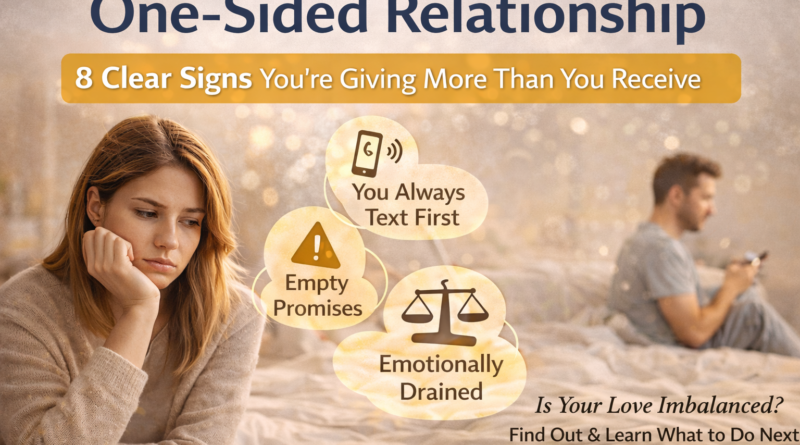
One-Sided Relationship: 8 Clear Signs You’re Giving More Than You Receive
A one-sided relationship can feel confusing, painful, and emotionally exhausting. At first, you may believe it’s just a temporary phase. But over time, you start to realize something deeper:
You are the one putting in most of the effort.
Healthy relationships require balance. Both people should feel valued, supported, and emotionally safe. But in a one-sided relationship, one partner gives far more time, energy, attention, and love than the other.
In this article, you’ll discover the most common signs of a one-sided relationship — and what you can do to protect your emotional well-being.
What Is a One-Sided Relationship?
A one-sided relationship happens when emotional investment is unequal.
One person may constantly:
- initiate conversations
- make sacrifices
- provide emotional support
- keep the relationship alive
While the other partner remains distant, inconsistent, or emotionally unavailable.
Over time, this imbalance can damage self-esteem and create emotional burnout.
Relationship experts explain that emotional imbalance often leads to stress and dissatisfaction over time. Psychology Today discusses how unequal effort can damage emotional connection.
8 Clear Signs of a One-Sided Relationship
1. You Always Initiate Contact
In a one-sided relationship, you are usually the first one to text, call, or plan time together.
If you stopped reaching out, the connection would likely fade.
Mutual effort is the foundation of a healthy relationship. Love should not feel like chasing.
2. Their Effort Feels Minimal or Inconsistent
Another major sign of a one-sided relationship is inconsistency.
They may show care sometimes, but it feels unpredictable.
This emotional uncertainty can create anxiety, because you never know where you stand.
Psychology shows that inconsistent affection can become emotionally addictive, making you crave small moments of attention.
3. You Feel Emotionally Drained Instead of Supported
A relationship should bring comfort, not constant exhaustion.
If you often feel:
- emotionally tired
- anxious
- unsupported
- lonely
It may be because you are carrying most of the emotional weight.
A one-sided relationship often turns love into emotional labor.
4. Your Needs Are Frequently Ignored
In a healthy partnership, both people care about each other’s emotional needs.
In a one-sided relationship, your needs may be dismissed.
You might hear:
- “You’re too sensitive.”
- “You expect too much.”
- “I don’t have time for this.”
Over time, you may stop expressing your needs, which leads to emotional neglect.
If your partner constantly dismisses your feelings, it may also be a form of emotional manipulation. You may want to read our guide on warning signs of gaslighting.
5. You Are Always the One Compromising
Compromise is normal in love.
But in a one-sided relationship, compromise becomes sacrifice.
You adjust your schedule, lower your expectations, and ignore your boundaries just to keep the relationship going.
A relationship should not require you to shrink yourself.
6. They Don’t Show Real Interest in Your Life
Do they ask about your thoughts, feelings, or goals?
Or does everything revolve around them?
A lack of curiosity is a major emotional red flag.
In a balanced relationship, both partners feel emotionally seen.
7. You Feel Alone Even When You’re Together
One of the most painful signs of a one-sided relationship is emotional loneliness.
Even in the same room, you may feel disconnected.
Emotional intimacy is not about physical presence — it’s about emotional engagement.
Emotional loneliness is often connected to subtle manipulation. Learn more in our post on psychological signs someone is emotionally manipulating you.
8. Deep Down, You Know It’s Not Balanced
Sometimes the clearest sign is your intuition.
If you constantly feel like you’re trying to earn love, effort, or attention…
That is not a healthy relationship.
Secure love feels stable. One-sided love feels stressful.
Why People Stay in a One-Sided Relationship
Many people remain stuck because of:
- fear of being alone
- hope the person will change
- emotional attachment
- low self-worth
- the “sunk cost fallacy” (“I invested so much already”)
But staying in a one-sided relationship often delays the healing you truly need.
According to the American Psychological Association, emotional attachment and fear of loneliness can keep people stuck in unhealthy relationship patterns.
What to Do About a One-Sided Relationship
Communicate Honestly
A healthy partner will listen when you say:
“I feel like I’m giving more than I’m receiving.”
Communication is the first step.
Stop Over-Giving
Pull back slightly and observe.
Does the other person step up?
One-sided relationships become clear when you stop doing all the work.
Set Emotional Boundaries
Your energy matters.
You deserve emotional reciprocity, not emotional exhaustion.
Know When to Walk Away
If nothing changes, leaving may be the healthiest option.
You deserve mutual love, not emotional survival.
In more extreme cases, imbalance can turn into a toxic dynamic. Our article on the stages of a narcissistic relationship explains how unhealthy patterns develop over time.
FAQ: One-Sided Relationships
Can a one-sided relationship become healthy?
Yes, but only if both partners are willing to change and invest equally.
Is a one-sided relationship toxic?
It can become emotionally harmful if the imbalance continues.
What is the difference between love and attachment?
Love is mutual. Attachment is often driven by fear of losing someone.
Final Thoughts: You Deserve Balanced Love
A one-sided relationship can slowly drain your happiness and confidence.
Real love is not about chasing effort.
It’s about partnership, respect, and emotional balance.
If you recognize these signs, take them seriously.
You deserve someone who meets you halfway.
Pingback: Psychology Explains: 11 Subtle Behaviors That Reveal Someone
Pingback: The Psychology of Motivation: Unlocking Your Inner Drive for